
















Second Academic Seminar – Prof. UV Luis Pentón Herrera
Prof. UV Luis Pentón Herrera’s seminar continued the VISION Center’s commitment to fostering meaningful academic dialogue on teaching, learning, and educational development.
In his engaging and thought-provoking presentation, Luis Javier Pentón Herrera, Professor at VIZJA University, explored the role of social-emotional learning (SEL) in multilingual teacher education and language teaching. The lecture began by inviting participants to reconsider what language is, moving beyond the idea of language as only grammar, vocabulary, and sounds, and toward an understanding of language as deeply connected to identity, emotion, culture, interaction, and belonging. Particular attention was given to the consequences of ignoring the social-emotional dimensions of language learning, including teacher stress, learner anxiety, disengagement, and the challenges teachers face when they are not prepared to respond to the emotional realities of classroom life.
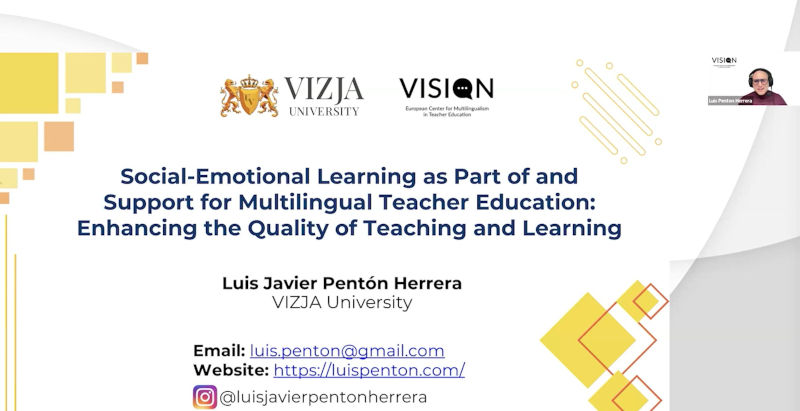
A central focus of the presentation concerned SEL as a meaningful part of language pedagogy rather than an additional or separate concern. Drawing on current scholarship and classroom-based examples, the talk highlighted how SEL can support multilingual learners’ motivation, participation, confidence, belonging, and language development. Prof. UV Luis Pentón Herrera also emphasized the importance of preparing teachers to recognize what may lie beneath students’ silence, anxiety, resistance, or disengagement, and to create learning environments where students feel safe enough to participate, communicate, and grow.
The VISION Center seminar provided a valuable space for reflection on multilingual education, teacher preparation, learner emotions, belonging, trauma-sensitive teaching, classroom relationships, and the quality of teaching and learning. The presentation sparked meaningful discussion about how language education can better support the whole learner and how teachers can be prepared to see, hear, and respond to the social and emotional dimensions of multilingual classrooms.